Web hosting
1984 Hosting for WordPress in Iceland: pricing and backups
1984 Hosting’s WordPress plans in Iceland, initial and renewal terms, migration, the Security Pack and backup limitations.
Read more →

Site appearance
Web hosting
WordPress on Cloud Containers, with resources shared among a server’s containers and optional infrastructure management.
Source published: · Source updated: · Editorial policy
Visit the official SiteHost website ↗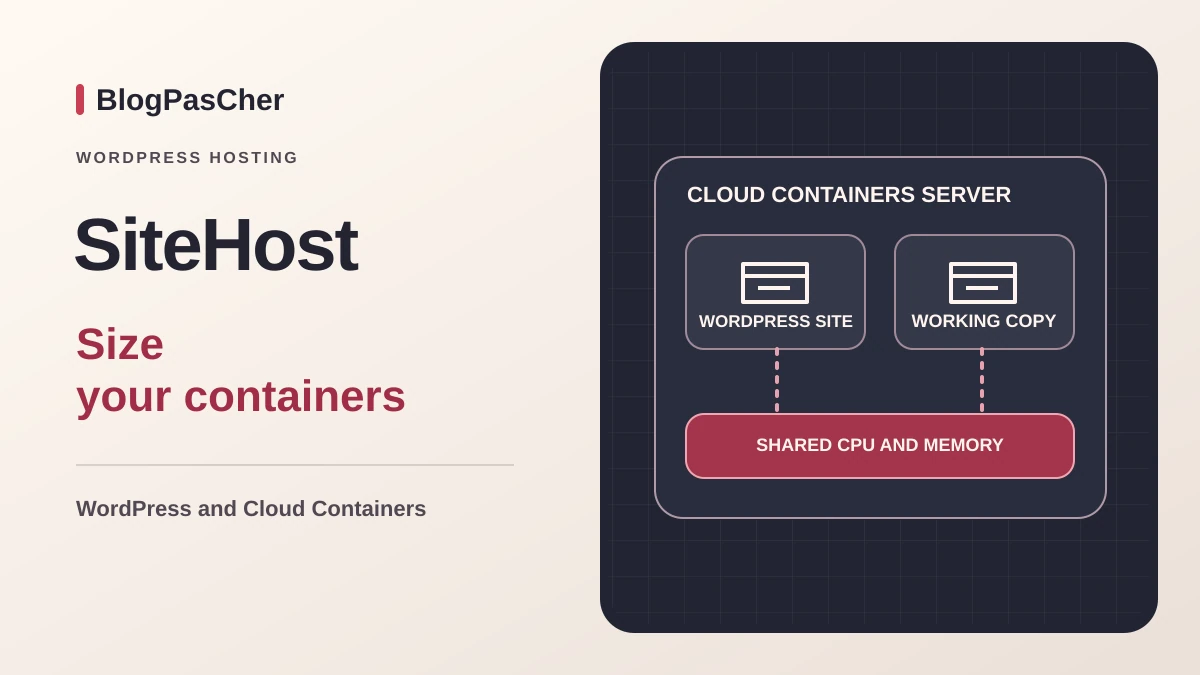
This profile is based on published offers and documentation. No new hosting benchmark or support test was performed for this translation.
Prices retain the market, currency and billing period described in the French source. Translation does not update a commercial quote. Confirm the final price, taxes and options before ordering.
| Plan | Price and billing | Resources and limits |
|---|---|---|
| Cloud Containers 1 Core | 35 NZD/month unmanaged or 235 NZD/month managed, excluding GST. Renewal: Same recurring monthly pricing recorded November 10, 2026. Changes and billing total according to contract. NZD excluding GST. Management, region, overages and fees depend on configuration. | 1 virtual core, 1 GB RAM, 10 GB NVMe, 50 GB international traffic and 2 TB domestic. Approximately 2 containers. Indicative container count. Shared CPU and RAM. Quotas and overages by region. |
| Cloud Containers 2 Cores | 80 NZD/month unmanaged or 280 NZD/month managed, excluding GST. Renewal: Same recurring monthly pricing recorded November 10, 2026. Changes and billing total according to contract. NZD excluding GST. Management, region, overages and fees depend on configuration. | 2 virtual cores, 2 GB RAM, 30 GB NVMe, 100 GB international traffic and 2 TB domestic. Approximately 20 containers. Indicative container count. Shared CPU and RAM. Quotas and overages by region. |
| Cloud Containers 4 Cores | 130 NZD/month unmanaged or 330 NZD/month managed, excluding GST. Renewal: Same recurring monthly pricing recorded November 10, 2026. Changes and billing total according to contract. NZD excluding GST. Management, region, overages and fees depend on configuration. | 4 virtual cores, 4 GB RAM, 55 GB NVMe, 200 GB international traffic and 2 TB domestic. Approximately 40 containers. Indicative container count. Shared CPU and RAM. Quotas and overages by region. |
SiteHost offers WordPress on Cloud Containers. Customers choose a server, then create containers for their sites and dependent services. This organization particularly interests teams able to manage access, a database and several environments. Server resources are shared among its containers. Tier selection therefore depends on their combined consumption.
The documentary record of November 10, 2026 distinguishes the server, management option and separately billed services. To decide whether the product fits, first identify who can maintain WordPress, respond to an incident and verify a restoration. The amount displayed for the server alone covers a different scope from the managed server.
The international page addresses customers in several countries. The FAQ documents an address outside New Zealand and GST adjustment in account details. French account holder eligibility, payment method and invoice must be confirmed for the chosen service.
For an agency, identify the account holder, domain owner and people authorized to modify containers. Also state how the client will retrieve files, database and settings at the end of the engagement. This allocation avoids a change of provider blocking site or archive access.
The Cloud Containers page advertises locations in Auckland, Sydney, Singapore, London and California. Pages devoted to international infrastructure mainly highlight New Zealand and Australia. Distinguish these presentations and verify regions actually offered for the ordered product. An old announcement or VPS-specific list is insufficient to guarantee a Cloud Containers location.
A site serving New Zealand customers may have a clear reason to be installed in Auckland. A French team mainly serving Europe can examine London if that region remains available and suits its needs. No hosting in France was established in the consulted material. Do not assign identical commercial specifications to every location without a quote.
Region also affects data transfer pricing and backup location. Asking where files, database and backups reside is more precise than simply seeking the company’s nationality. Suitable geographic distance does not replace validation of project contractual obligations.
The WordPress pricing consulted on November 10, 2026 lists 35 NZD per month excluding GST for one virtual core, 1 GB memory and 10 GB NVMe. The same tier with management lists 235 NZD. The two-core, 2 GB memory, 30 GB tier costs 80 NZD unmanaged or 280 NZD managed. At four cores, 4 GB and 55 GB, pricing is 130 or 330 NZD.
The difference is 200 NZD per month in all three cases. The management page also lists 200 NZD monthly excluding GST for its standard level and presents a separate higher level. To compare columns, check included interventions and features reserved for managed servers, especially image updates and file restoration from the panel.
The observed table displays recurring monthly prices. No separate first-cycle discount was established. The same amounts serve as starting and next-cycle references, subject to contract, pricing changes and region. Ask for the first charge, possible fees and renewal date. To avoid a distorted comparison, have the same management level priced across all three sizes.
The catalog displays New Zealand dollar prices excluding GST. Help covers customers neither based nor taxed in New Zealand. For a French account holder, account configuration, invoice and applicable tax treatment remain to be checked. The FAQ also mentions card processing fees. Their rate and conversion fees depend on the selected payment method.
Twelve months at 80 NZD represent 960 NZD excluding GST. With management at 280 NZD, the projection rises to 3,360 NZD. This constant-price calculation helps forecast annual expense. Recorded prices are monthly, and excess traffic, out-of-scope interventions and independent services remain additional.
The table indicates approximately two, twenty and forty containers for the three sizes studied. The provider specifies that memory and cores are shared and a single container can use all resources. For a store, record database size, image-processing peaks, imports and scheduled tasks. Also count validation environments and services used by the sites.
The three sizes advertise 50, 100 and 200 GB of international traffic respectively, plus 2 TB domestic traffic. The table lists 0.10 NZD per additional international GB and 0.05 NZD per additional domestic GB, excluding GST. Check the domestic traffic definition, available quota and pricing for the selected region, especially outside New Zealand.
One hundred and fifty GB above the international allowance would represent 15 NZD excluding GST at displayed rates. To track consumption, separate resources delivered to visitors from operations such as media transfer or restoration. Ask about the plan’s counting method and alerts before a campaign.
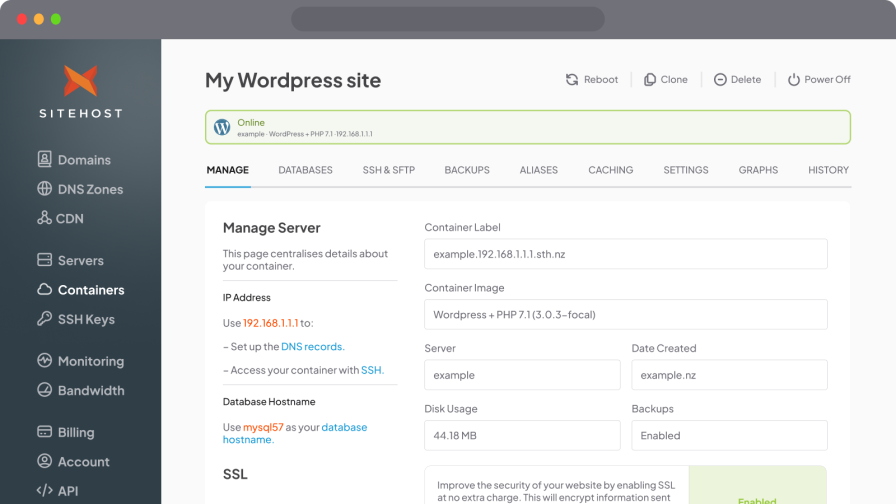 SiteHost panel for an example site. The screenshot shows PHP 7.1 and MySQL 5.7, not the versions to choose today. — Image: SiteHost.Open full-size screenshot ↗
SiteHost provides a WordPress image and a panel for creating containers. The documented workflow covers selecting the server and region, creating the container, databases and SSH or SFTP users. For a team familiar with these concepts, this organization may provide a shared framework across projects. For a volunteer without technical skills, it requires learning or a provider’s intervention.
Assigning access by environment helps limit an operator’s permissions. However, document authorized accounts, their keys and secrets required for site operation. A developer’s departure should trigger access revocation without blocking updates or file retrieval by the account holder.
The integrated cache can be enabled to reduce some repetitive processing. A cart, account page or personalized response needs appropriate rules. Before adding a plugin, check the cache already provided. On a copy, verify that cart and account pages are excluded.
The management option targets monitoring, maintenance and infrastructure patches. Documentation on automatic container updates restricts them to servers using Server Management. It describes replacing images with stable versions during a chosen maintenance window. This operation concerns the application environment supplied by SiteHost.
This mechanism does not demonstrate complete maintenance of WordPress core, theme and every plugin. An agency must still define who checks site compatibility, licenses and client-specific features. An infrastructure management contract can be useful while leaving these tasks to the developer.
The health check described after an update notably uses a homepage response, with a custom check option. A responding page does not prove payment, booking or private access works. Choosing the maintenance window and planning a business-function check afterward remain relevant, particularly for transactional sites.
Cloud Containers advertises daily backups retained off-site for fourteen days. Directories cited in help are application, config and crontabs. The panel also allows an on-demand point. From the relevant container, open Backups, name the copy, then run Backup Now. Check the new point’s timestamp. Identify separately the database and volumes on which the site depends.
Panel restoration is restricted to managed servers. From Backups, choose the point, then Restore. Help says the service first copies the current state and restores files. The database requires a separate operation from an export. For an unmanaged server, help describes SSH access to backup files and retrieval of the desired content.
To prepare recovery, compare SQL dump and file dates. Test them together in a protected target with separate credentials. After application restoration, open a public page, administration and the affected business function. If the result does not match the intended point, recover the validated recent copy or restore selectively. For an order site, measure operations potentially lost between daily backups and prepare reconciliation.
The panel can clone a container to a destination, with an option to copy certain databases into new databases. A copy carries over files and settings stored in code. Check URLs, credentials and SQL connection before opening the clone. SiteHost’s WordPress database connection guide specifies that container connections use the MySQL or MariaDB service hostname given for the version.
For migration from another provider, record PHP and SQL versions, domain, tasks and access. Keep files and an SQL export, then prepare a protected target. Ensure the new WordPress uses its own database. Disable real emails, external tasks and payments, then verify pages, administration and business functions. Transfer assistance cost still needs clarification in the quote.
Overwriting replaces selected target content. Identify transfer direction and retain a recent point before every operation. On a transactional site, plan recovery of operations received since the first copy before switching DNS. If it fails, restore old records and reconcile new data before reopening the old site.
The website, guides and documented menus are in English. The panel is proprietary to SiteHost. French interface availability and a French-speaking technician remain to be confirmed. For a team spread across countries, designate who receives alerts, understands technical replies and can authorize interventions.
Help directs routine requests to panel tickets. It lists a 24-hour emergency telephone channel and a temporary code for verifying the account holder’s identity by phone. The terms provide for intervention on an unmanaged server to be billed at the agreed rate. Help also states that an emergency call may incur fees if the problem does not originate in provider systems. For a managed plan, check intervention scope for an application failure, faulty plugin or theme change.
SiteHost offers AI Platform, a separate service accessible without hosting or a domain with the provider. Documentation advertises an OpenAI-format-compatible API and usage-based billing calculated per request. Previous-month usage is invoiced at the beginning of the following month. The page distinguishes input tokens, cached inputs and output for text-generating models.
As of November 10, the public catalog lists Qwen3.8-27B for inference, plus embedding and ranking models for search. The provider states that models run on its New Zealand infrastructure. This record describes the separate service. WordPress offers consulted do not establish inclusion of credits, a page builder or writing assistant.
WordPress integration requires a tool or development, a dedicated key and a rule for transmitted data. Before adding it to a client site, define the budget, data that may be sent and site behavior if the key or model changes. AI costs should be tracked separately from container costs.
A self-sufficient agency can examine an unmanaged server to organize several environments and retain deployment control. It must then have someone responsible for maintenance, backups, metrics and incidents. The expected result is consistent portfolio operation, not guaranteed capacity calculated from twenty or forty advertised containers.
A business without an operations team can examine the managed level, with a quote specifying responsibilities retained by its developer. The monthly supplement should be compared with the time and interventions actually covered. If the need is only a small site managed by a beginner, container complexity and English support may make the overall arrangement disproportionate.
In both approaches, starting with a site inventory and validation environment allows needs to be assessed before switching. Upgrading does not replace analysis of a blocked task, slow query or misconfigured cache.
The Cloud Containers page advertises cancellation within the first seven days under its commercial policy. General terms require at least thirty days’ notice, subject to contractual duration, and exclude refunds for unused subscription time. Confirm the rule applicable to your configuration and retain the agreed effective date.
Product pages and help cite 99.9% availability for Cloud Containers. General terms display 99.99% for several categories, including cloud services, and describe a credit schedule. Ask which commitment covers your service, with exclusions, measurement method and claim deadline.
Before departure, retrieve files, databases, tasks, access and server settings to reproduce elsewhere. Verify restoration and operation of domain-related services. To decide from France, bring together recurring pricing with the correct management level, regional network rates and account recovery terms.
Use these references to check the features, requirements and limitations described. Reading documentation is not a practical test.
English translation of the reviewed French edition. Code examples retain their original identifiers, comments and output strings for reproducibility. Linked exercise files and original screenshots may contain French. No new practical tests or price checks are implied by translation.
1984 Hosting’s WordPress plans in Iceland, initial and renewal terms, migration, the Security Pack and backup limitations.
Read more →Compare 34SP.com WordPress containers, shared memory, staging copies, downloadable snapshots and site migration.
Read more →Compare AEserver’s managed WordPress prices and check whether your network must be split into independent installations before migration.
Read more →