Web hosting
1984 Hosting for WordPress in Iceland: pricing and backups
1984 Hosting’s WordPress plans in Iceland, initial and renewal terms, migration, the Security Pack and backup limitations.
Read more →

Site appearance
Web hosting
Four WordPress plans and a simulation of the resource boost period before a campaign.
Source published: · Source updated: · Editorial policy
Visit the official Jump.BG website ↗
This profile is based on published offers and documentation. No new hosting benchmark or support test was performed for this translation.
Prices retain the market, currency and billing period described in the French source. Translation does not update a commercial quote. Confirm the final price, taxes and options before ordering.
| Plan | Price and billing | Resources and limits |
|---|---|---|
| Blogger Start | 66.46 EUR including VAT displayed for twelve months. Renewal: Confirm the next renewal amount and any discount. Prices recorded on 11 November 2026. Annual equivalent of 5.54 EUR/month. Short-cycle list price: 7.66 EUR/month. | 20 GB disk space, 1.40 GB RAM, 140% vCPU, 12 MB/s writes and 20 parallel processes. 25 parallel MySQL connections and a database capped at 1,024 MB. Verify resource boost and backup retention. |
| Blogger Uni | 122.70 EUR including VAT displayed for twelve months. Renewal: Confirm the next renewal amount and any discount. Prices recorded on 11 November 2026. Annual equivalent of 10.22 EUR/month. Short-cycle list price: 13.29 EUR/month. | 60 GB disk space, 1.40 GB RAM, 160% vCPU, 20 MB/s writes and 20 parallel processes. 25 parallel MySQL connections and a database capped at 1,024 MB. Verify resource boost and backup retention. |
| Blogger Pro | 189.17 EUR including VAT displayed for twelve months. Renewal: Confirm the next renewal amount and any discount. Prices recorded on 11 November 2026. Annual equivalent of 15.76 EUR/month. Short-cycle list price: 22.49 EUR/month. | 150 GB disk space, 2.20 GB RAM, 200% vCPU, 30 MB/s writes and 25 parallel processes. 25 parallel MySQL connections and a database capped at 1,024 MB. Verify resource boost and backup retention. |
| Blogger Ultra | 276.09 EUR including VAT displayed for twelve months. Renewal: Confirm the next renewal amount and any discount. Prices recorded on 11 November 2026. Annual equivalent of 23.01 EUR/month. Short-cycle list price: 30.67 EUR/month. | 250 GB disk space, 2.50 GB RAM, 240% vCPU, 50 MB/s writes and 40 parallel processes. 25 parallel MySQL connections and a database capped at 1,024 MB. Verify resource boost and backup retention. |
A Plovdiv association is preparing a membership campaign on WordPress. The page must remain available at launch and during reminders. Jump.BG offers four WordPress plans and advertises a temporary resource boost. The association needs to know the base plan limits and when this boost begins and ends. A peak may be anticipated within a campaign window without all site activity being concentrated on those same days.
The exercise compares several start dates against a fictional seven-day schedule. It checks whether days exceeding the normal processor-minute budget fit within the window and remain below the limit used in the scenario. A day can fall within the boost period and still consume too much. The case helps determine when to launch an operation and prepare for the return to the base plan. The team tests at low volume on a copy, compares measurements with its schedule and checks the exact boost terms for its account with the provider.
Jump.BG offers four Blogger plans in its WordPress range. On 11 November 2026, the Bulgarian page selector displayed VAT-inclusive totals of 66.46, 122.70, 189.17 and 276.09 EUR for twelve months, in Start, Uni, Pro and Ultra order. The storefront rounds the monthly equivalents. Monthly billing costs more over the same duration. The public cards provide both subscription benchmarks. Request a quote covering the billing cycle that qualifies for the boost and the next renewal date.
The product page states that prices include VAT. The Bulgarian tax authority publishes a standard rate of 20%. If the VAT-inclusive 7.66 EUR is billed at this rate, that represents approximately 6.38 EUR before tax and 1.28 EUR of tax per month. The pricing grid does not distinguish WordPress hosting renewal prices. The association should therefore budget for the next cycle using the invoice or a written offer, including whether any discount continues. The page explains that a card can be added for automatic payments. Check the account setting and due date before relying on this option.
A free domain is advertised with the first annual order for certain plans. Jump.BG lists Blogger Uni, Pro and Ultra among the eligible plans and applies the standard rate when the domain renews. For example, the portal displays 16.31 EUR for one year of .com renewal, subject to the price at that time. An association that already owns its address should list this item separately in the budget.
The range publishes limits for disk space, RAM, vCPU share, disk writes and parallel processes. Moving from Start to Uni increases the advertised vCPU and write throughput, while the RAM figure in the table stays the same. For a site mainly approaching a memory limit, check what an upgrade would actually change. The stated visitor volumes are estimates based on a cached WordPress configuration. The association’s form and plugins may behave differently.
Traffic, mailboxes and file counts are advertised without a numerical account-level cap for the stated categories. Mailboxes share disk space with the site, and the server filesystem has its own capacity. The terms cap each database at 1,024 MB and describe a procedure if that limit is exceeded. The table also shows twenty-five parallel MySQL connections per plan. CPU minutes and vCPU percentages measure different things. Ask whether a CPU time limit applies, over what period and how it is measured.
The offer advertises a seven-day CPU and RAM boost, on request, up to three times per paid twelve-month period with an active annual plan. The advertised level matches the next plan up, with an automatic return to the paid plan. Confirm resources, dates, time zone and account eligibility, especially if you already have the largest plan. Boost requests go through the sales department. The site targets the Bulgarian market, and the company states that its headquarters are in Sofia. Verify the data center assigned to this account and the one storing its backups.
Jump.BG advertises cPanel, LiteSpeed, Let’s Encrypt SSL and the Softaculous installer for WordPress. The page highlights LiteSpeed caching and presents WordPress maintenance as a separate service. That service’s terms describe work on a site and updates. Before the campaign, appoint the person responsible for core, theme and form updates and clarify the purchased support level. Verify access to the account’s acceptance-testing features and the PHP versions the site needs.
The local storefront is in Bulgarian. The knowledge base has a WordPress page in English, and the international storefront presents its own catalog. cPanel language settings depend on its version and configuration. The WordPress interface language and the form language are separate choices. The WordPress page advertises round-the-clock technical assistance by phone and email. Confirm response languages, the channel for the technical case and the processing time for a sales request for a boost. The displayed sales link provides no contractual campaign preparation time.
The storefront links to external AI assistants for questions about Jump.BG. The plan table does not document an AI website generator within WordPress or creation credits attached to the account. For the campaign, the association can prepare text and a schedule from its approved program. Resource availability depends on the tasks the site performs, whether the membership page was prepared manually or with outside assistance.
Write the association’s schedule before requesting the boost. Include the opening of membership registrations, reminders, validation sessions and heavy tasks already planned. For example, the team might move thumbnail generation or an internal export before postponing an announcement to members. For each task, note its usual duration, when it runs and the services it uses. Image generation and a series of submissions can happen on the same day without using the same resource. Record processing, memory and application errors separately.
On a site with measurements available in cPanel, record an ordinary day and a period when the form is busier. The Resource Usage module may be available depending on the CloudLinux configuration. Record the available values, time zone and measurement duration. If the panel only displays percentages or reached limits, ask the provider to explain what they mean. The model uses minutes per day to make planning easy to read. The team must replace its assumptions with the data available for its own account.
Before the campaign, download a copy of the database and files the team must be able to bring back into service. The product page advertises daily remote backups and JetBackup. The terms generally describe seven backups, with possible exclusions for some large files or archive types. In particular, check that media are present and check the database date before an update. To test the form on a copy, use a test mailbox and isolate external notifications.
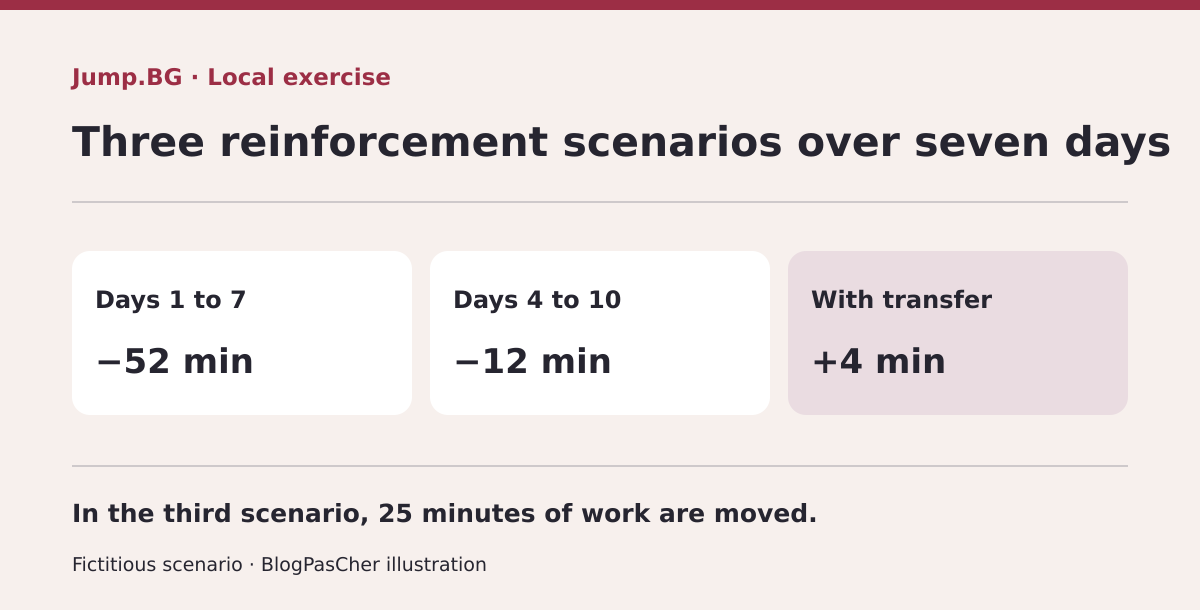 In the model, the days 4–10 window is sufficient only after postponing a task by 25 minutes. — Illustration by BlogPasCher.Open full-size illustration ↗
Extract the profile’s archive. Run this command in the extracted folder.
The file models fourteen days and two fictional budgets: 90 CPU minutes per day under normal conditions and 130 during the boost. These values are used for the local calculation. The seven-day duration starts on the selected day and includes that day. Days 4, 8 and 10 concentrate the load, at 110, 126 and 142 minutes respectively in the initial schedule. The program reports days exceeding the applicable budget and the headroom at the tightest point.
The first scenario activates the boost from day 1 to day 7. Days 8 and 10 remain above the normal budget. The second activates it from day 4 to day 10. All three peaks fall within the window, but day 10 still exceeds the boosted budget by 12 minutes. In the third scenario, the association moves a 25-minute internal task from day 10 to day 11. Day 10 falls to 117 minutes and day 11 to 80. Every day meets its applicable budget. The smallest headroom is then four minutes on day 8. Compare the details with RESULTAT-JUMP-BG.json.
In a copy of the script, move only 10 minutes from day 10 to day 11. That leaves 132 minutes on day 10, exceeding the limit by two minutes even during the boost. This check forces you to consider the volume moved and the capacity of the receiving day. In a real project, the association can also defer maintenance before the first peak and retain a reserve for variations. The model ignores peaks within a day and other resource limits. Actual measurements of memory, processes and form response remain necessary to assess the campaign.
node EXERCICE-JUMP-BG.cjsBefore launch, request confirmation of the dates and limits actually being changed. Keep the start and end times in the same time zone as the metrics, then compare the table’s period with the communications schedule. A CPU and RAM boost may leave other limits at their original level. For each rescheduled task, confirm that it can wait until the planned day and assign someone to restart or disable it if the team detects an incident.
On a private copy, submit the form with a test account and address. Open the saved record and confirmation message, and record how long background tasks take. After publication, observe a legitimate submission and the usual logs. An expected result is a displayed confirmation, a registration saved exactly once and a received notification. A cached page may load correctly while the form or its tasks still require server work. Test public content and the form separately.
At the end of the window, check the site’s metrics and task queue. Postpone nonessential tasks if the base level can no longer finish them on time. Keep a table showing the periods when submissions were observed and the actions postponed. If the form fails, post a notice on the page and preserve registrations already saved before intervening. Prepare any database restoration to avoid overwriting these writes. Compare acceptance-test results with metrics over a normal period before concluding that an upgrade is still necessary.
Start with the tier that supports the association’s normal activities. Blogger Start and Uni may suit a small site depending on its usage, with different disk space and vCPU capacities. Pro and Ultra provide more memory and parallel processes. When several days remain above capacity after reorganizing the schedule, price a permanent higher tier with the provider. The maximum frequency of three boosts leaves planning flexibility for occasional events during a paid period. Revisit the same reasoning if the form, theme or number of scheduled tasks changes.
Jump.BG advertises free inbound migration. Before requesting this service, clarify whether it covers files, the database, the domain and mailboxes. The terms notably govern preparation and the remaining contract duration with the old host. Staging lets you check the form and its dependencies while the old site remains available. The destination site must provide a way to retrieve your own files and database after the event.
To leave the service, note the billing cycle end date, payment method and data-access deadline. The terms require payment at the start of each period. They also permit restrictions for nonpayment. Export the data and check the copy before access ends. If the switch to the destination fails, retain the previous installation and the log of registrations already received. The next campaign can use the schedule values and observations from the busiest day to decide between a temporary boost and a higher base plan.
Use these references to check the features, requirements and limitations described. Reading documentation is not a practical test.
English translation of the reviewed French edition. Code examples retain their original identifiers, comments and output strings for reproducibility. Linked exercise files and original screenshots may contain French. No new practical tests or price checks are implied by translation.
1984 Hosting’s WordPress plans in Iceland, initial and renewal terms, migration, the Security Pack and backup limitations.
Read more →Compare 34SP.com WordPress containers, shared memory, staging copies, downloadable snapshots and site migration.
Read more →Compare AEserver’s managed WordPress prices and check whether your network must be split into independent installations before migration.
Read more →