Web hosting
1984 Hosting for WordPress in Iceland: pricing and backups
1984 Hosting’s WordPress plans in Iceland, initial and renewal terms, migration, the Security Pack and backup limitations.
Read more →

Site appearance
Web hosting
Three tax-inclusive annual prices in Mongolia and a local exercise separating two languages in a cache.
Source published: · Source updated: · Editorial policy
Visit the official Datacom website ↗
This profile is based on published offers and documentation. No new hosting benchmark or support test was performed for this translation.
Prices retain the market, currency and billing period described in the French source. Translation does not update a commercial quote. Confirm the final price, taxes and options before ordering.
| Plan | Price and billing | Resources and limits |
|---|---|---|
| Standard | 242,000 MNT including tax per year displayed. Renewal: Confirm the future WordPress amount in the offer or renewal invoice. Price recorded on November 10, 2026. Annual price. Installment possibilities subject to payment-method terms. | 1 site, 2 cores, 2 GB RAM, 5 GB disk and 250 GB monthly traffic. Database backup advertised. Confirm file scope, retention and detailed computing limits. |
| Performance | 330,000 MNT including tax per year displayed. Renewal: Confirm the future WordPress amount in the offer or renewal invoice. Price recorded on November 10, 2026. Annual price. Installment possibilities subject to payment-method terms. | 2 sites, 4 cores, 4 GB RAM, 15 GB disk and 350 GB monthly traffic. Database backup advertised. Confirm file scope, retention and detailed computing limits. |
| Business | 396,000 MNT including tax per year displayed. Renewal: Confirm the future WordPress amount in the offer or renewal invoice. Price recorded on November 10, 2026. Annual price. Installment possibilities subject to payment-method terms. | 3 sites, 6 cores, 6 GB RAM, 35 GB disk and 500 GB monthly traffic. Database backup advertised. Confirm file scope, retention and detailed computing limits. |
An association in Ulaanbaatar publishes a WordPress calendar in Mongolian and English. It wants each reader to see the correct version and a Mongolian correction to appear before the next event even when the English version does not change. Datacom sells annual WordPress hosting with SSL, automatic updates and caching. The product also presents CDN use. The exercise varies keys and invalidation in a fictional cache to distinguish confusion between languages from an old response in the correct language.
The entry-level plan hosts one site. The scenario therefore uses one installation and two language paths. This lets editors share media and common information while keeping titles and dates separately editable. To adopt it, the association must be able to observe the received language, recognize each page’s revision and understand which cache intervenes after publication. It also needs a copy of media and translation settings if an automatic update makes a page unavailable. The three plans are compared with these operations in mind for a site remaining manageable by a small local team.
Datacom publishes the same amounts on Mongolian and English WordPress pages. The three plans are advertised annually and billed in Mongolian tugriks, currency code MNT. The Mongolian table states that prices include VAT and repeats the three amounts under WordPress. The investment authority lists a standard rate of 10%. For Standard, 242,000 MNT divided by 1.10 gives an illustrative base of 220,000 MNT and VAT of 22,000 MNT at that rate.
The sales page mentions installment options through Storepay and Pocket, with different payment counts. The association can retain the annual price as its baseline and separately check eligibility, schedule and total due with its payment method. The public renewal guide describes generating an invoice from product management for additional services. The WordPress table lists no separate renewal rate. Read the amount, date and arrangements applicable to hosting on the renewal invoice or confirm them in the written offer.
The table’s WordPress line mentions a domain change for a new service and a 10% deduction for cancellation within fourteen days. The product FAQ mentions a full refund in its question. Its answer mentions the possibility of requesting a refund within fourteen days. The table details the deduction. For Standard, a 10% deduction from 242,000 MNT is 24,200 MNT. Check the clause’s scope and net amount for a specific request before relying on this estimate. Domain or email-subscription prices appear in other sections.
Standard hosts one site, Performance two and Business three. The proposed calendar keeps two languages in one WordPress installation, with two paths, one media library and shared editorial access according to roles. If the association chooses two independent installations, it needs two slots or another arrangement. An additional slot also accommodates a test copy when a clone counts as a site. Datacom does not explain this counting in the profiles consulted.
The range is classified as domestic WordPress hosting in Datacom’s store. The sales page advertises automatic caching and CDN. “Domestic” helps identify the offer and market. Confirm the assigned origin, backup and visitor-serving point-of-presence locations for any residency commitment. The offer provides no usable public region list per plan. A team serving people in Mongolia and readers elsewhere can record display times from both areas during acceptance testing.
Cores and RAM are displayed specifications. Details of guaranteed resources, PHP concurrency, file limits and traffic-overage handling still need to be obtained. A cached response may come from the browser, WordPress server or CDN point. For news corrected at the last minute, identify which layer served the response and which can be refreshed. Page caching can reduce server work for anonymous visits. Still measure tasks reaching WordPress, such as administration, scheduled publication and media processing.
The WordPress descriptions advertise free SSL, automatic updates and database backup. The help-center guide describes hosting management access, WordPress Manager and installation. Visible labels are partly English, with steps written in Mongolian. Establish the current panel version, available languages and PHP-version selection for the association’s account. Automatic theme and plugin update rules and the ability to return to a previous version deserve a range-specific answer.
The public site offers WordPress pages in Mongolian and English. Technical procedures examined are written in Mongolian. The English page displays a telephone number, email and support-request access and links to video resources. An English public site lets the English-content editor read the offers. Confirm language availability in telephone conversations, ticket replies or email and response times by channel. Readers can identify beforehand the section for billing questions and the one for cache intervention.
The AI chat button appears in the help section of both product language versions. Its documented purpose is conversational assistance. Confirm languages actually understood, quotas, exchange retention and human handoff. Product documentation connects no site generator, WordPress translator, in-administration writing assistant or creation credits to this button. Editors review both calendar variants separately. Problems can be described to support with public paths and fictional identifiers while keeping access details and database exports in team-designated storage.
The English box states WordPress database backup. The domestic catalogue also mentions backup alongside SAS SSD storage. These descriptions leave file inclusion, frequency, retention and restoration options unresolved. Ask which point can be downloaded or restored without affecting the public site, who triggers it and how long it takes. A frequently corrected calendar may require an export closer to the latest publication than a rarely changed overview page.
Keep a copy containing both translations in the database, media, theme, plugins and settings. Identify the configuration linking two page versions and defining language paths. WordPress documentation distinguishes files from database in a complete backup. Verify that the point opens on a private copy before relying on it on the eve of an event. If CDN settings are external to WordPress, keep a separate record of rules and accessible invalidation commands.
Choose two reference pages with simple public content, a stable address per language and a visible revision indicator in the text. On the Mongolian page, an event time can change from 16 to 17 hours while English text stays unchanged for the exercise. Short identifiers ease recording and prevent similar layouts from being mistaken for correct responses. Also check the language declared on the HTML element, which WordPress can generate for the theme. If a page declares the correct language but displays the wrong text, retain both observations.
Before each trial, record expected versions, modification time, public URLs and available purge mechanism or expiry period. Records should let someone else repeat the workflow the next day even if actual site pages have changed meanwhile.
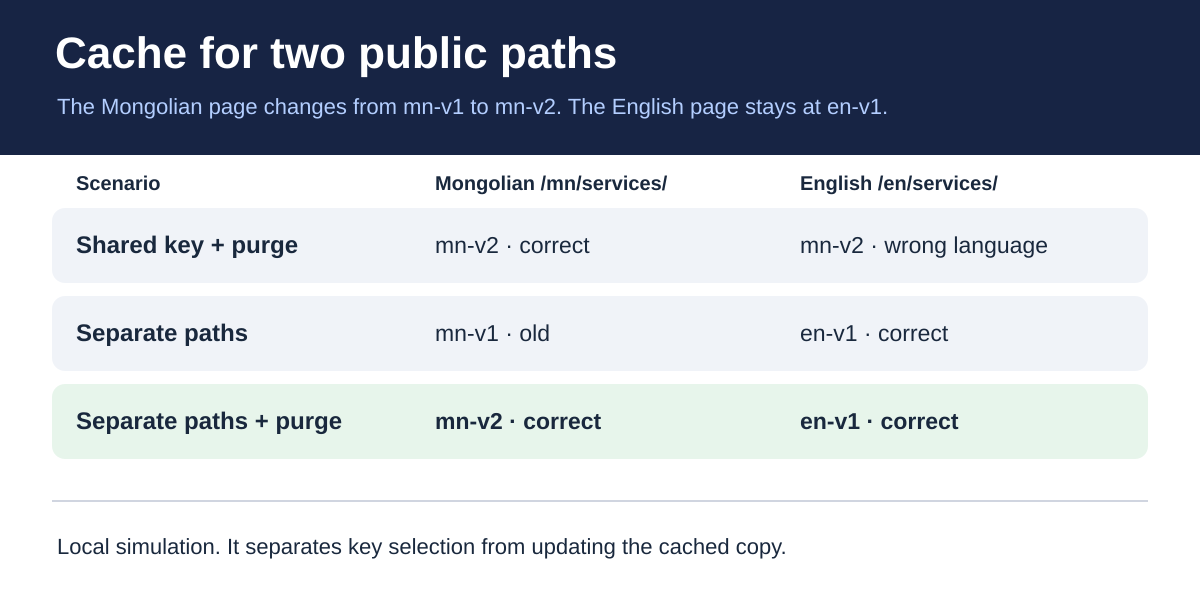 The simulation separates languages and checks invalidation of a single revision. — Illustration by BlogPasCher.Open full-size illustration ↗
In the extracted ZIP directory, run node EXERCICE-DATACOM-MN.cjs. It builds two public pages in memory and simulates a dictionary cache. The first key uses the last segment of /mn/services/ and /en/services/, shared by both. The second retains the full path. Each trial warms the cache by requesting both pages, replaces the Mongolian revision with mn-v2, then measures language, revision and the presence of an existing cached entry on both new reads.
In the first trial, the short path gives the English page the Mongolian response cached by the first read. Even after invalidating that shared key, the first Mongolian response recreates an entry reused by both paths. The English check fails. In the second trial, paths are distinct but the Mongolian entry remains at mn-v1 after modification. English remains correct. In the third, paths are distinct and the Mongolian entry is invalidated. The first read retrieves mn-v2, while the English page still returns en-v1 from its own cache.
Read details in RESULTAT-DATACOM-MN.json. Failures appear for English, then Mongolian, and the third configuration passes. The exercise retains initial and post-change read results to identify when the defect appears. A page in the correct language with an old revision needs a different investigation from one served in the wrong language. If language is correct on load and only the correction is delayed, examine publication, expiry or invalidation. If two paths receive the same document in a controlled test, also check origin translation and distinction between variants during caching.
The simulation represents one site, two public paths and one modification. It runs offline and does not reproduce Datacom’s implementation. The association can change read order in a copy of the exercise to observe which revision first populates the shared entry.
On a private copy, first verify that each path renders the correct translation before enabling or warming cache. Test language-switching links in both directions and see whether the final address retains the correct prefix. Record response code, reference text, language attribute, page title and time. An incorrect origin result can persist after every purge. Correct routing or translation linking before resuming CDN measurement.
Record a first read and repeated read of each path from an anonymous context. Save available headers when they help distinguish response age or the serving layer. Compare results from a fresh browser context to reduce the effect of a locally retained copy. When the environment provides direct origin access, use the team’s supplied procedure. A response obtained by changing the URL with a parameter does not establish the state of the canonical public path.
Change only Mongolian text and repeat both reads. If the tool supports per-URL purging, purge the corrected page and measure again. Check other pages repeating the same date, such as the homepage and event list. They may have their own copies. If only broader purging is available, check how long pages take to return in both languages and specify who can trigger it. When no purge is accessible, measure actual propagation delay and compare it with the correction deadline the team promises.
Replace the domain with your private copy’s domain and use the intended access mechanism. Age headers and any CDN indicators provide clues. Also check the actual returned text, language and revision in the browser.
Record the URL, expected and received revision, publication time and receipt time. Repeat from a second connection if readers span two geographical areas and the CDN may serve different copies. Before-and-after records for the same modification give support dated observations and help distinguish a regional issue from one reproducible through every connection.
curl -sS -D - -o /dev/null https://recette.example.test/mn/services/
curl -sS -D - -o /dev/null https://recette.example.test/en/services/Standard may suit the calendar when both languages fit one installation, media leaves headroom within 5 GB and a working copy is available elsewhere. Performance becomes relevant if the team wants a second slot or more disk. Business offers a third slot and the largest displayed space. The association can plan a storage reading after a quarter and compare media growth with available headroom, accounting for backup extraction during restoration.
Before subscribing, request details on renewal amount, file-copy options and purge access. The publishing owner must know which action they can perform alone and which requires support. If cache cannot be purged per URL, measuring refresh delay in both languages helps determine when to publish urgent corrections. Changes also affecting the homepage must be included in that measurement.
To re-enable caching, have someone review each path’s language and revision before and after a correction. The check passes when the Mongolian version receives the corrected date within the chosen deadline, the English version retains expected text and both pages remain accessible on a cold visit and a second visit. The initial scenario can also be repeated with English requested first. Any doubt about language or propagation warrants a record before restoring the previous setting.
The team keeps dated screenshots of every step and the database/file restoration procedure. With a new WordPress or translation-plugin version, repeat the same two reference paths. Annual cost, available space and ability to correct information on time can then be judged against the same case.
The priced offers here belong to the domestic catalogue. Confirm inbound migration inclusion, cost and recovery time after closure for this range. To prepare departure, retrieve the database, files and translation settings while access remains open. Test the copy at the destination and retain DNS data and invalidation settings separately. If enabling caching fails acceptance testing, return to the latest validated setting, then repeat both pages before accepting migration or the modification.
Use these references to check the features, requirements and limitations described. Reading documentation is not a practical test.
English translation of the reviewed French edition. Code examples retain their original identifiers, comments and output strings for reproducibility. Linked exercise files and original screenshots may contain French. No new practical tests or price checks are implied by translation.
1984 Hosting’s WordPress plans in Iceland, initial and renewal terms, migration, the Security Pack and backup limitations.
Read more →Compare 34SP.com WordPress containers, shared memory, staging copies, downloadable snapshots and site migration.
Read more →Compare AEserver’s managed WordPress prices and check whether your network must be split into independent installations before migration.
Read more →