Web hosting
1984 Hosting for WordPress in Iceland: pricing and backups
1984 Hosting’s WordPress plans in Iceland, initial and renewal terms, migration, the Security Pack and backup limitations.
Read more →

Site appearance
Web hosting
Six plans in Rwandan francs and an exercise for selecting a complete backup based on the recovery objective.
Source published: · Source updated: · Editorial policy
Visit the official Bazasoft website ↗
This profile is based on published offers and documentation. No new hosting benchmark or support test was performed for this translation.
Prices retain the market, currency and billing period described in the French source. Translation does not update a commercial quote. Confirm the final price, taxes and options before ordering.
| Plan | Price and billing | Resources and limits |
|---|---|---|
| WP_Economy | 54,000 RWF for one year. 13,500 RWF displayed for one month. Renewal: Confirm a renewal price separate from the one-year rate. Prices recorded on November 11, 2026. Equivalent to 3,000 RWF/month over 36 months, or a calculated 108,000 RWF. Check the billed cycle, domain and VAT. | 1 site, 1 database, 5 GB SSD, 1 GB RAM and 100,000 inodes. Monthly backups in the detailed table. 50 GB traffic, 2 mailboxes. Confirm retention and restoration. |
| WP_Personal | 36,000 RWF for one year. Renewal: 72,000 RWF displayed after the first year on the annual cycle. Confirm the three-year cycle. Prices recorded on November 11, 2026. Equivalent to 2,000 RWF/month over 36 months, or a calculated 72,000 RWF. Check the billed cycle, domain and VAT. | 1 site, 1 database, 10 GB SSD, 2 GB RAM and 200,000 inodes. Weekly backups in the detailed table. 100 GB traffic, 4 mailboxes. Confirm retention and restoration. |
| WP_Startup | 45,000 RWF for one year. Renewal: 90,000 RWF displayed after the first year on the annual cycle. Confirm the three-year cycle. Prices recorded on November 11, 2026. Equivalent to 2,500 RWF/month over 36 months, or a calculated 90,000 RWF. Check the billed cycle, domain and VAT. | 2 sites, 2 databases, 20 GB SSD, 2 GB RAM and 300,000 inodes. Daily backups in the detailed table. Unlimited traffic advertised, 20 mailboxes, terminal. Confirm retention and restoration. |
| WP_Business | 67,500 RWF for one year. Renewal: 135,000 RWF displayed after the first year on the annual cycle. Confirm the three-year cycle. Prices recorded on November 11, 2026. Equivalent to 3,750 RWF/month over 36 months, or a calculated 135,000 RWF. Check the billed cycle, domain and VAT. | 5 sites, 5 databases, 40 GB SSD, 3 GB RAM and 500,000 inodes. Daily backups in the detailed table. Unlimited traffic and mailbox count advertised, terminal. Confirm retention and restoration. |
| WP_Special | 99,000 RWF for one year. Renewal: 198,000 RWF displayed after the first year on the annual cycle. Confirm the three-year cycle. Prices recorded on November 11, 2026. Equivalent to 5,500 RWF/month over 36 months, or a calculated 198,000 RWF. Check the billed cycle, domain and VAT. | 10 sites, 10 databases, 100 GB SSD, 4 GB RAM and 700,000 inodes. Daily backups in the detailed table. Unlimited traffic and mailbox count advertised, terminal. Confirm retention and restoration. |
| WP_Premium | 148,500 RWF for one year. Renewal: 297,000 RWF displayed after the first year on the annual cycle. Confirm the three-year cycle. Prices recorded on November 11, 2026. Equivalent to 8,250 RWF/month over 36 months, or a calculated 297,000 RWF. Check the billed cycle, domain and VAT. | 20 sites, 20 databases, 200 GB SSD, 4 GB RAM and 900,000 inodes. Daily backups in the detailed table. Unlimited traffic and mailbox count advertised, terminal. Confirm retention and restoration. |
A newsroom in Kigali publishes several short news items and new media every week. It is considering Bazasoft Rwanda for its WordPress hosting and wants to know how much work it could lose in an incident. The plans display monthly, weekly or daily schedules depending on the package. The advertised schedule and the actual age of the latest point containing both files and database answer different questions. A backup table may show a recent date while a corresponding archive is missing or fails to open.
This case proposes setting an acceptable content-loss limit. The person responsible for hosting records available points and tests their restoration privately. Another person knows the expected posts, images and settings and can confirm what the copy contains. The local exercise compares several schedules and rejects a recent point with incomplete content. It helps distinguish a theoretical interval, an observed point and full site recovery. Bazasoft’s terms and plan cards are examined separately before inferring what the hosting can handle.
The WordPress page displays six plans in Rwandan francs, currency code RWF. The table separates a one-year purchase from the monthly equivalents advertised for thirty-six months. The calculated three-year total multiplies the monthly equivalent by thirty-six. Ask whether the entire cycle is payable upfront, the invoice total and the renewal amount for the selected cycle. The renewal price displayed for an annual plan does not set the price for a three-year plan.
WP_Economy also displays 13,500 RWF for one month and does not distinguish renewal from the one-year price. For the five other plans, the page lists a rate after the first year on the annual cycle. WP_Startup thus rises from 45,000 to 90,000 RWF, an increase of 45,000 RWF at the displayed rate. The terms state that promotions do not repeat and the renewal invoice is generated fourteen days before the term ends. The cards advertise a free domain for the first year. Its eligible extension and renewal are separate items to check.
The Rwanda Revenue Authority uses a standard rate of 18%. The WordPress table does not specify whether tax is included. If WP_Startup’s 45,000 RWF excludes tax and is fully subject to the standard rate, the first-year total would be 53,100 RWF. Use the amount and VAT shown on the applicable quote in the budget, with the domain separate. The terms also govern the money-back guarantee and specifically exclude domains, some additional services and setup fees.
To size the account, use the detailed table’s figures. The general presentation advertises daily backups. The table divides them into a monthly schedule for WP_Economy, weekly for WP_Personal and daily for the other four plans. The terms state that copies made for shared-hosting purposes are provided without guarantee. Confirm retention duration, the ability to export a copy and restoration costs for the selected plan. Installation and database counts matter when the newsroom hosts a second site or keeps an acceptance-testing copy. Media size and file count grow at different rates. The first depends on image and video volume. The second increases with every image size generated by the theme, even when each individual file remains small. To keep headroom, record both metrics before deciding where to store an extracted copy.
The cards advertise two mailboxes on Economy, four on Personal and twenty on Startup. The three higher plans display unlimited mailbox counts. A terminal is listed for Startup, Business, Special and Premium. Check SSH permissions and restoration options in a quote when the account has no terminal. The terms subject resource use to fair sharing and provide for suspension when certain limits are exhausted unless an arrangement is in place. They exclude using the account as archive storage. Moving historical copies elsewhere prevents the site and its only backup from depending on the same account.
Bazasoft operates in Kigali and presents its services to a Rwandan audience. The WordPress offer does not specify, by plan, the assigned server’s country or the backup storage country. Before publishing content under a residency commitment, separately check where the site, email and copies are processed. Restoration may use storage or procedures different from those of the server responding to readers.
The range advertises SSL, WordPress installation through Softaculous, caching and malware protection. The terms describe a courtesy migration for cPanel shared hosting covering one source cPanel account, without a guaranteed timeframe. Before moving a newsroom, distinguish WordPress installation from maintenance and ask who covers core, plugin and theme updates and restoration after an incident. Support for a PHP version in the table is insufficient to establish compatibility with the existing site. Keep a record of the theme, essential plugins and version used before testing.
The WordPress pages consulted are available in English, French and Kinyarwanda. Bazasoft documents installation from cPanel in French. The assigned account and portal have their own language settings. The cPanel publisher documents a choice depending on the version and feature enabled by the host. Check WordPress article rendering, panel menu language and technical-ticket language separately.
The contact page presents chat, tickets, email and telephone details. The table advertises round-the-clock ticket support. Ask which language the team can use for an incident, which channel accepts restoration requests and how to provide a backup record. Response time and answers in French or Kinyarwanda remain to be confirmed. The offer page documents no AI WordPress site generator, credits or access to an integrated editorial assistant. The advertised automated protection addresses hosting operations. Here, the decision to restore rests with the newsroom and the person administering the site.
For a newsroom, start with a concrete example. If the site stops responding on Wednesday at ten in the morning and you restore a database from Monday at five in the afternoon, every change between those times may need to be redone. The period between the restorable point and the incident is forty-one hours here. It measures content at risk over time. The time needed to bring the site back online is another metric. A very recent archive can take hours to transfer, while an old archive can open quickly. Assess both.
In this fictional case, the newsroom accepts redoing up to one day of work. With a twenty-four-hour objective, record separately when the point was produced, when the backup finished and when both objects became available. Use the same timezone in the record, for example Kigali time. If the table shows a date without a time, ask how to obtain the timestamp. When the database and files are generated by different tasks, ask how the panel identifies the two matching elements.
Choose reference items before the trial. A recent news item and its image provide a joint check of database and media. Add an older page to ensure partial recovery has not replaced the whole site with an extract. An essential plugin, a permalink rule and a test account let you check settings. For registrations or comments, use a non-personal reference item. Record these objects outside the hosting account so you can compare a restored copy even when the live site is unresponsive.
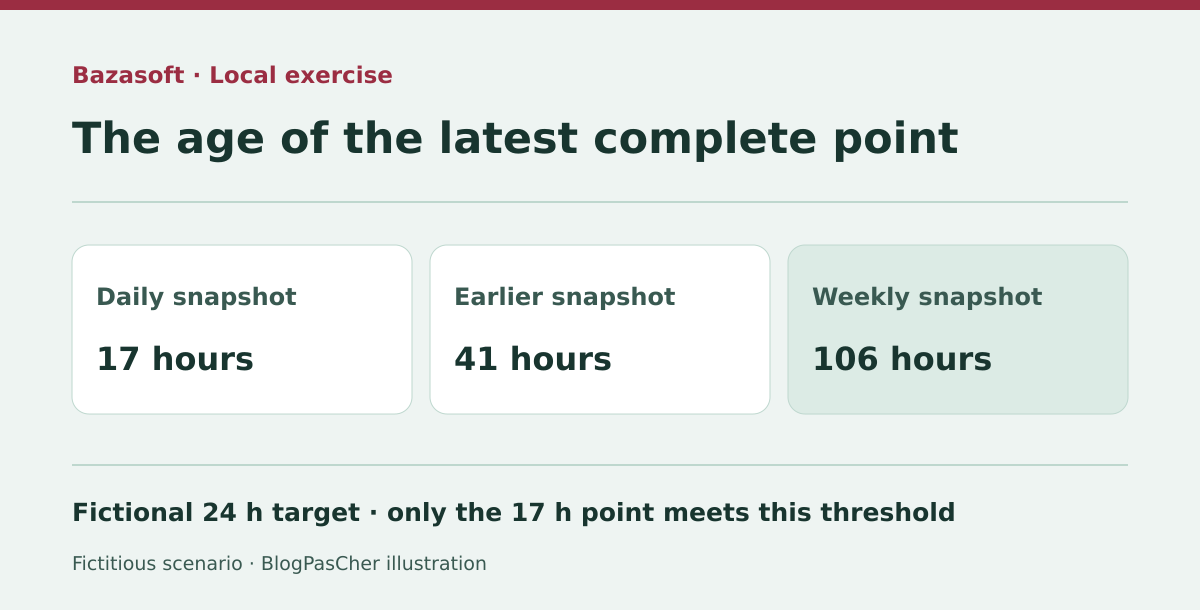 The latest complete restore point may be older than the latest date displayed in the backup table. — Illustration by BlogPasCher.Open full-size illustration ↗
Download and extract the exercise archive into a local directory. The Node.js script uses invented data and small gzip archives built in memory. It compares checksums, opens the archives and verifies that their identifier refers to the same point. It selects the most recent usable point before the fictional incident. The “ageHeures” field gives the time elapsed since that point. The twenty-four-hour threshold applies to the newsroom in this practical case. Change it in a copy to check another requirement, then adjust the assertion expectations.
The usable weekly point is one hundred and six hours old. The usable daily point is seventeen hours old and meets the objective. When the recent database archive is truncated, the test falls back to a usable point forty-one hours old. The script makes the same choice if the recent archive’s checksum matches but its bytes are not readable gzip. Finally, it refuses to combine one day’s database with another day’s files. If no consistent pair exists in the list, the report selects no point.
The exercise simulates backup objects and the schedule. It restores no WordPress database and does not contact Bazasoft. A file that opens and whose checksum matches can still be incomplete relative to the site. In the real test, repeat the same reasoning and add reference-item checks in an isolated installation. For media files, open the restored public page and display the image in context. An entry in an inventory alone does not prove that a reader can open the resource.
node EXERCICE-BAZASOFT-RW.cjsFor the prospective account, request a list of available points and a written procedure explaining how to retrieve them. Distinguish what the panel shows, what you can export yourself and what must go through support. The terms describe administrative copies made at night for some servers and limit their guarantee. The WordPress table, meanwhile, displays a frequency for each plan. The account must therefore let you check the oldest useful point, the schedule actually available and the time required to make an export available.
Prepare an isolated WordPress installation and a separate database before importing. Disable outgoing notifications and prevent indexing of this copy, then ensure the live address does not point to it. Load the files and database from the same point. Check imported file permissions and connection to the dedicated database. If the team needs to adapt URLs, use the migration tool’s intended mechanism to preserve serialized settings. Keep the old instance active until the result is checked and the responsible person has chosen the next step.
For a small page that rarely changes, compare the budget for a single-installation plan with your own export frequency. For a newsroom that can lose only one day, the table supports examining Startup or a higher plan, which advertise daily backups. The offer alone does not establish that the latest useful database and files will be accessible within the day. Validate this in an account demonstration or plan more frequent independent copies. The test should also confirm whether a ticket is required and how the provider helps in an emergency.
Calculate the budget from the cycle you can accept and the subsequent price where published. For Startup, check the first year’s 45,000 RWF, the advertised 90,000 RWF thereafter and taxes shown in the quote. Ask what happens to the domain at renewal. If the documents show only a monthly equivalent over thirty-six months, request the payment schedule and billed amount before comparing it with an annual offer. Export fees, independent space and the time of someone available to restore the site form part of the project cost.
Keep an export of the database, media and necessary settings with another service controlled by the newsroom. Also store the latest restoration procedure and support contact details. Mark in your calendar when the renewal invoice may be generated. If you change hosts, verify that the new site and its recovery point work before the previous service ends. A folder containing the reference-item list and date of the latest trial allows another person to repeat the checks without relying on the memory of whoever performed the first restoration.
Use these references to check the features, requirements and limitations described. Reading documentation is not a practical test.
English translation of the reviewed French edition. Code examples retain their original identifiers, comments and output strings for reproducibility. Linked exercise files and original screenshots may contain French. No new practical tests or price checks are implied by translation.
1984 Hosting’s WordPress plans in Iceland, initial and renewal terms, migration, the Security Pack and backup limitations.
Read more →Compare 34SP.com WordPress containers, shared memory, staging copies, downloadable snapshots and site migration.
Read more →Compare AEserver’s managed WordPress prices and check whether your network must be split into independent installations before migration.
Read more →