Web hosting
1984 Hosting for WordPress in Iceland: pricing and backups
1984 Hosting’s WordPress plans in Iceland, initial and renewal terms, migration, the Security Pack and backup limitations.
Read more →

Site appearance
Web hosting
Three plans in Paraguay and a local two-session exercise to check the responses served from cache.
Source published: · Source updated: · Editorial policy
Visit the official Astralis website ↗
This profile is based on published offers and documentation. No new hosting benchmark or support test was performed for this translation.
Prices retain the market, currency and billing period described in the French source. Translation does not update a commercial quote. Confirm the final price, taxes and options before ordering.
| Plan | Price and billing | Resources and limits |
|---|---|---|
| Básico | 29,000 PYG per month or 290,000 PYG per year, public prices. Renewal: Automatic under the terms unless cancelled before the next cycle. No specific amount published. Recorded on November 10, 2026. In PYG, domain separate. Paraguayan law requires IVA-inclusive price display; check the breakdown. | 1 GB SSD, 1 mailbox, approximately 1 GB RAM, a maximum of 1 vCPU, 500 IOPS and 90 processes displayed. Confirm space for testing. Daily copies advertised, with retention unpublished. |
| Intermedio | 49,000 PYG per month or 490,000 PYG per year, public prices. Renewal: Automatic under the terms unless cancelled before the next cycle. No specific amount published. Recorded on November 10, 2026. In PYG, domain separate. Paraguayan law requires IVA-inclusive price display; check the breakdown. | 3 GB SSD, 3 mailboxes, approximately 1.8 GB RAM, a maximum of 1.8 vCPU, 1,000 IOPS and 150 processes displayed. Confirm space for testing. Daily copies advertised, with retention unpublished. |
| Avanzado | 99,000 PYG per month or 990,000 PYG per year, public prices. Renewal: Automatic under the terms unless cancelled before the next cycle. No specific amount published. Recorded on November 10, 2026. In PYG, domain separate. Paraguayan law requires IVA-inclusive price display; check the breakdown. | 10 GB SSD, 10 mailboxes, approximately 2.5 GB RAM, a maximum of 2.5 vCPU, 2,000 IOPS and 250 processes displayed. Confirm space for testing. Daily copies advertised, with retention unpublished. |
Astralis offers WordPress hosting in Paraguay with OpenLiteSpeed, LiteSpeed caching and the Enhance panel. The fictional Asunción store uses WordPress for its catalogue and WooCommerce for orders. It wants to speed up public product pages while checking that someone opening a cart receives only their own content. The decision is based on two different sessions, a public route and workflows containing personal data.
The price in guaranis, media storage and support scope help determine the plan. To decide whether to enable caching, the workshop also needs to distinguish a reusable public page from a response dependent on a visitor or an action in progress. A cache can make a page faster while serving the wrong response. The local exercise demonstrates this distinction with fictional carts.
This profile connects the advertised tools with checks a store can perform before making a new configuration available. It separates Enhance features, cache-plugin settings and backup measures. The exercise produces a result for an intentionally overbroad rule and for a rule protecting session-specific responses. The decision for the real site depends on checks of its own pages and plugins.
On November 10, 2026, Astralis displayed three plans in Paraguayan guaranis, currency code PYG. Básico costs 29,000 PYG per month or 290,000 PYG per year, Intermedio 49,000 or 490,000 PYG, and Avanzado 99,000 or 990,000 PYG. Each annual amount equals ten advertised monthly payments. For Intermedio, twelve monthly payments at the current rate would total 588,000 PYG, compared with 490,000 PYG paid annually. The 98,000 PYG difference explains the advertised two free months. Compare the payment methods over the same duration and retain the amount payable upfront.
Paraguayan law sets a general rate of 10% and requires taxpayers to display IVA-inclusive prices. The Astralis price list does not break out the tax. Check the total and its breakdown in the billing summary. The terms advertise an electronic invoice within forty-eight hours after payment. To budget the commitment, request a final amount in PYG and the tax breakdown for the store’s account holder. All three cards state that the domain is billed separately. A store that already owns a domain can retain its management and track its renewal date separately.
The plans clause provides for automatic renewal for another period and a cancellation request before the next billing date, through the channels listed in the terms. It ties the charge to the applicable price and allows the provider to change prices. No specific second-year amount or numerical cancellation notice period for this product appears in the consulted sources. The store can record today’s annual price separately from the renewal price still to be confirmed, then retain dated evidence of its chosen option.
Básico, Intermedio and Avanzado advertise 1, 3 and 10 GB of SSD storage and 1, 3 and 10 mailboxes respectively. The comparison lists approximately 1, 1.8 and 2.5 GB of RAM, maximums of 1, 1.8 and 2.5 vCPU, then 500, 1,000 and 2,000 input/output operations per second. It also displays 90, 150 and 250 under simultaneous processes. These limits do not predict how many people can pay at once. The store needs to measure its database, media and mailboxes, and ask which uses count toward each quota.
The comparison specifies MariaDB, FTP access and scheduled tasks, together with SSH access described as limited. Confirm the plan’s permissions and tools before relying on a procedure requiring a shell or WP-CLI. OpenLiteSpeed and LiteSpeed Cache address the need to cache compatible pages. The catalogue, mini-cart, checkout and payment services do not have the same profile. A storage limit can obstruct a test copy even when a product page loads quickly.
Astralis presents itself as a local operator and identifies Ventus Astralis E.A.S. Unipersonal in its terms. These pages do not establish the country, city or data center assigned to the machine hosting the site or its copies. For a store wishing to keep data in Paraguay, ask where the database, backups and email are located for the selected plan. Also record the role of any proxy or CDN enabled by the customer. The seller’s headquarters and the storage location answer two separate questions.
The WordPress page advertises WordPress installation and management in Enhance. It mentions reviewing updates, managing themes and plugins, and diagnostic tools. Confirm which automatic settings are active on a new site and which remain the holder’s responsibility. The advertised free SSL protects the connection to the site. You must still check the covered name, the certificate on the destination and redirect behavior when the store uses several names.
The price list and terms are in Spanish. Astralis advertises local support in Spanish and publishes a ticket portal and WhatsApp channel. No support hours or quantified response commitment for these plans was verified. Enhance documentation lists English, French and Spanish in beta among its languages and describes a per-profile setting. This establishes the software’s possibilities. Confirm the languages actually available in this provider’s panel, and distinguish the panel’s language from that of the person answering.
The WordPress price list and described functions document neither an included generative builder nor AI credits. Diagnostic, security and image-optimization functions are not enough to establish a generative-AI offering. For the store, the confirmed functions are installation, the panel and the caching stack. Any generative plugin chosen later is a separate service, with its own subscription, supported languages and data-processing rules.
The price list advertises daily backups on all three plans. It does not specify retention depth, the time zone used for backup times, the precise components or the time required to make a copy available again. Before relying on a copy, identify an available date, verify that it contains files and the database, and ask whether restoration can target a test site without overwriting the active site. For a store, daily scheduling indicates frequency. Acceptable loss depends on the orders, returns and changes received between two recovery points.
Enhance documentation describes Websites > Manage > Backups, followed by downloading site data and email data. The site export contains files and databases and excludes cron tasks. The developer notes a 2 GB download limit when the panel’s server uses OpenLiteSpeed or LiteSpeed. The offer specifies OpenLiteSpeed for the website. The panel’s engine and exact limit still need confirmation. The exit test is to download and open an export before an incident. Record the panel version, archive formats and the procedure appropriate to the volume.
Native import is documented for another Enhance site. For a move to a different panel, also prepare the files and an independent SQL export. Add redirect rules, scheduled-task settings and an inventory of domain-related services. Keep an email inventory and check its separate export process. Astralis terms allow price changes, and the service remains available until the end of the specified period when a plan is cancelled. Test downloading and reading while access remains open. The consulted offer does not detail assistance or pricing for an incoming migration.
In the ZIP linked under “Prepare your site,” run EXERCICE-ASTRALIS.cjs from its folder with Node.js. The supplied result was obtained using Node 22.16.0. The script prepares two fictional carts: a water bottle for A and a calabash for B. It also associates a distinct account marker with each session. The in-memory cache handles simulated requests and runs neither WordPress, a web server nor a payment. Here, MISS, HIT and BYPASS indicate the program’s decisions. The model lets you test the logic before examining headers actually emitted by the store.
In the first pass, the rule caches every response using the path alone as the key. A’s request to /panier produces a cache miss and then stores PANIER-A-GOURDE. B opens the same path and receives a cache hit containing A’s content. The JSON result marks this rule refuser. To check that the control really reproduces the defect, compare each response’s body field. Checking only the response code or general appearance would miss the leak.
The second-pass rule caches only a GET request for the public product page, with neither parameters nor cookies in this model. A and B receive the same public description, first generated and then reused. The six requests from the two sessions to cart, checkout and account bypass the cache and return each session’s own value. The script also checks the fictional add parameter, a checkout POST and the product page with a cookie. Those three cases bypass caching. This rule is a conservative test policy. The store then decides which content is truly public on its own pages, according to its theme, plugins and catalogue settings.
node .\EXERCICE-ASTRALIS.cjs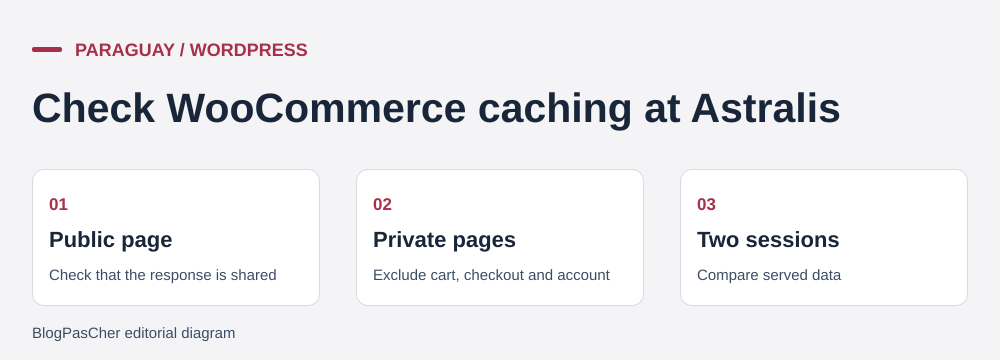 Guidance for preparing a targeted restore. — Illustration by BlogPasCher.Open full-size illustration ↗
On a private copy with fictional accounts, open WooCommerce, then Réglages > Avancé, and record the pages assigned to cart, checkout and account. Turn that list into the URLs actually served, including site variants and payment-plugin routes. In LiteSpeed Cache > Cache > Excludes, check Do Not Cache URIs for sensitive routes not automatically recognized by the configuration. WooCommerce and LiteSpeed document default exclusions for the three main pages. Plugins, session cookies and URL actions may require additional rules. Record the actual add parameter from the store. The local model uses a translated string to make its role visible.
LiteSpeed documents that the OpenLiteSpeed server does not support ESI fragments. Other products offer architectures that do, but their presence is not advertised for this plan. For the store, prioritize checking that personalized pages bypass the public cache. In two isolated browser profiles, fill A and B with different items, then alternate visits to the public product page, cart, checkout and account. In the Network tab, read the response header and served content. Depending on the configuration, X-LiteSpeed-Cache-Control: no-cache helps confirm exclusion. Also check any proxy cache, which may apply rules different from those of the WordPress server.
To prepare rollback, record the settings before the test and the purge order. If A sees B’s data or an action response is reused, disable caching for the affected route and purge every layer that may have retained it. Repeat the workflow in new sessions. If the discrepancy persists, turn off page caching for the affected scope while locating the responsible rule. A purge alone removes old content, but a faulty rule can recreate it. The test allowing you to proceed checks both each session’s response and the persistence of its own cart.
For the Asunción catalogue, Intermedio can serve as a comparison point if Básico provides too little room for media and a private copy. The chosen plan must cover measured usage and the time required for recovery. Clear guarani pricing and detailed quotas help with this calculation. VAT, renewal cost, data location and access to restoration on a copy remain quote questions. Also ask which access will remain available for separate website and email exports.
Accept the cache configuration when each session receives its own cart, checkout and account, and the public product page remains identical when it contains no session data. Check adding and removing an item, recalculating totals and returning to the product page. For interactions calling a payment service, verify on the copy using authorized test mechanisms and fictional data. Record URLs, the purge date and observed headers. If headers indicate public caching or content is wrong, restore the previous rule and check the workflows again.
Public-page caching can then be extended one route at a time. Start with routes whose content is identical for visitors without a session. A change to the theme, mini-cart, proxy or payment can change this classification. The same two-session check remains applicable after those changes. The team decides who can disable the affected layer and where to find the previous configuration. It keeps the test result and a checked copy of the site separate from current commercial data.
Use these references to check the features, requirements and limitations described. Reading documentation is not a practical test.
English translation of the reviewed French edition. Code examples retain their original identifiers, comments and output strings for reproducibility. Linked exercise files and original screenshots may contain French. No new practical tests or price checks are implied by translation.
1984 Hosting’s WordPress plans in Iceland, initial and renewal terms, migration, the Security Pack and backup limitations.
Read more →Compare 34SP.com WordPress containers, shared memory, staging copies, downloadable snapshots and site migration.
Read more →Compare AEserver’s managed WordPress prices and check whether your network must be split into independent installations before migration.
Read more →